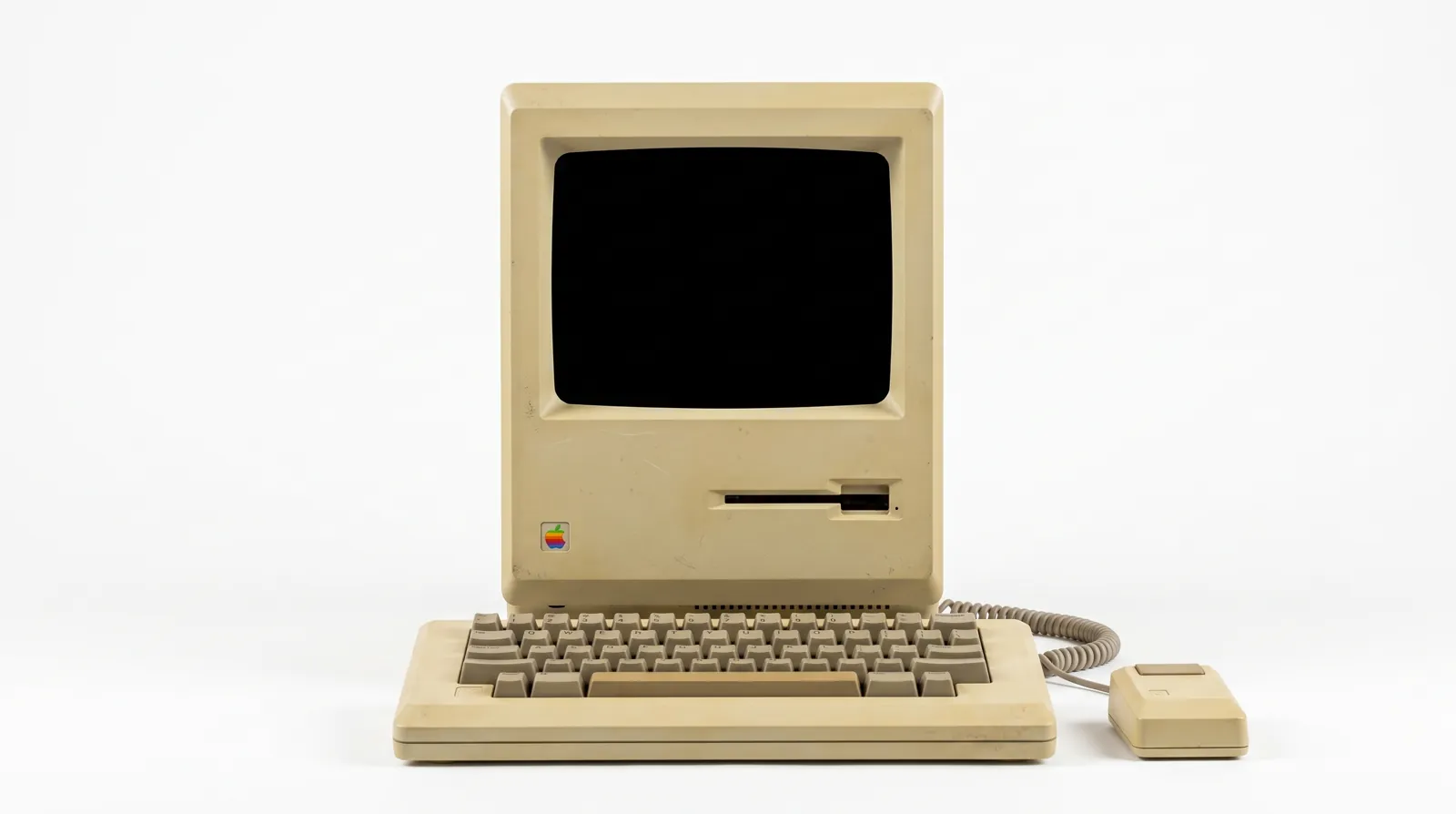
Forty years ago this was the whole computer — one screen, one keyboard, a hundred and twenty-eight kilobytes. Everything since has been the same idea taken apart and rebuilt smaller. Which is, more or less, what I do all day.
I build the whole thing.
Science, markets, web, and a knowledge engine. Designed, written, and shipped by one person. If you have something hard to build, I'd like to hear about it.
Astrometry Pipeline
A Python pipeline that measures how bright a supernova is from telescope images. It calibrates the camera against known reference stars, then reports the supernova's brightness in standard astronomical magnitudes, with uncertainties.

Quantitative Validation Framework
Combinatorial purged cross-validation with a deflated-Sharpe correction, built to catch strategies that only look profitable by luck. Nineteen strategies tested on seven years of real Databento data.

abegerstein.com
The site you are looking at. No template and no page-builder — every component, animation, and performance decision designed and written deliberately.

QuantVault Second Brain
A 10,743-entry Obsidian knowledge base spanning eight domains. Not a notes folder — a structured, cross-linked knowledge graph with a consistent authoring methodology and a retrieval layer wired directly into Claude.

Open for freelance work.
Here's what I build most often. The list isn't exhaustive, so if you have a real problem worth solving, reach out.
Custom Websites
I build marketing sites, portfolios, landing pages, and full product sites in Next.js, React, and Tailwind, then host them on Vercel or wherever you already are.
Data Pipelines
I write Python that takes messy, real-world inputs and turns them into clean, structured outputs you can actually trust.
Full-Stack Apps
I take an app from idea to deployed product, owning the frontend, the backend, and the database from end to end.
One-Off Scripts
If there's a task you keep doing by hand every week, I'll automate it so it quietly runs itself.
Anything I can build
If it's software and you have a problem worth solving, ask, because the unconventional projects are usually the most interesting ones.
Curious, multi-disciplinary, and only just getting started.
I'm eighteen, a recent graduate of Albuquerque Academy. This fall I head to the University of Michigan in Ann Arbor to study Aerospace Engineering with a minor in Business.
But the throughline of everything I do is software. It's the discipline I keep coming back to, because it lets me chase whatever I'm curious about: rigorous validation infrastructure for quantitative markets, a 10,743-entry knowledge architecture, scientific data pipelines that turn raw telescope frames into brightness measurements, and the portfolio you're reading right now.
I understand every line I ship. Working software is the baseline. Software you can stand behind is the standard.

The principles behind everything I build.

Have something worth building?
I'm open for freelance work: websites, data pipelines, full-stack apps, and custom scripts. If it's software and you have a real problem, let's talk.